

By 2026, the world of digital marketing has completely moved beyond the familiar list of “blue links” we’ve known for decades. Google’s SGE (Search Generative Experience) algorithm no longer simply lists results—it generates answers, provides recommendations, and actively shapes user decisions.
So, in this new AI-driven landscape, can a website survive by simply “existing”?
The answer is simple: No.
At Bravix Creative, the technologies we use—Next.js 16 and React Server Components (RSC)—are designed precisely for this shift. In this article, we’ll explore how modern web architecture aligns with AI-driven SEO in 2026 and how you can multiply your organic traffic.
1. Google SGE and AI-Powered Search: How the Rules Have Changed
In the past, keyword stuffing or simply building backlinks was enough.
But SEO in 2026 is built on Intent Optimization.
Google SGE doesn’t just scan your content—it evaluates whether your website can be used as a trusted source in AI-generated answers.
AI systems prioritize websites that:
- Deliver fast responses
- Provide structured data
- Are technically flawless
The hierarchical structure of Next.js 16 allows AI crawlers to understand your content within seconds, increasing your chances of being featured as a “recommended source.”
This means more than just traffic—it means authority and trust (E-E-A-T).
2. Next.js 16 and the New Role of Performance in SEO
In 2026, Google’s Core Web Vitals have evolved.
It’s no longer just about page speed—INP (Interaction to Next Paint) is now critical.
With Next.js 16, the new Turbopack engine improves both development and runtime performance by up to 60%, directly addressing this metric.
A fast-loading website:
- Retains users longer
- Improves engagement
- Optimizes crawl efficiency
Thanks to React’s new use cache directives, even dynamic data can be delivered with near-static performance.
This is the 2026 equation:
“Speed is no longer a feature. It is ranking itself.”
3. React Server Components (RSC): Moving the Load to the Server
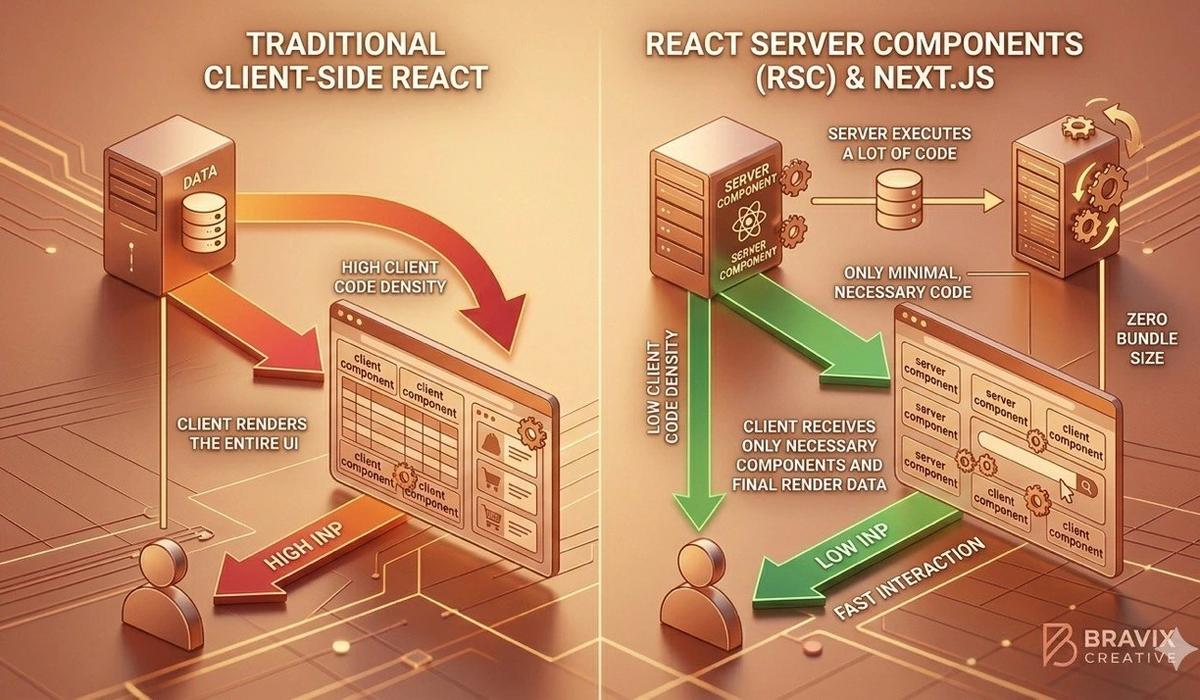
The era of sending massive JavaScript bundles to the browser is over.
With React Server Components, most of the logic runs on the server.
So what does this mean for SEO?
- Zero Client-Side Burden: Bots don’t wait for heavy JavaScript execution
- Faster Indexing: Content is delivered as ready HTML
- Better Mobile Experience: Faster loading even on low-end devices
In 2026, over 80% of traffic comes from mobile. RSC ensures your site performs flawlessly across all devices.
4. Semantic SEO and Content Depth: Feeding AI Systems
Google now evaluates content with a deeper question:
“Is this written by a real expert?”
With the flexibility of Next.js, every blog post can be enriched with:
- Structured data (JSON-LD)
- Rich snippets
- Semantic hierarchy
But technical setup alone is not enough.
Instead of saying:
“Next.js is good”
You need to deliver insights like:
“How Next.js 16’s Partial Prerendering improves conversion rates in e-commerce.”
Real depth wins.
At Bravix Creative, every project in our portfolio acts as a real-world proof of experience, one of the core E-E-A-T signals.
5. Dynamic Content with Static Speed: Partial Prerendering (PPR)
One of the biggest breakthroughs in modern web development is Partial Prerendering (PPR).
It allows static and dynamic parts of a page to work together seamlessly.
For example:
- Product descriptions load instantly (static)
- Personalized recommendations stream in (dynamic)
This hybrid model signals to Google that your site is both:
- Fast
- Up-to-date
And that’s a powerful combination.
For competitive keywords, this can be the difference between ranking and being invisible.
6. Trust and Authority: Combining E-E-A-T with Technology
Experience, Expertise, Authority, and Trust (E-E-A-T) are at the core of SEO in 2026.
So how do you strengthen these signals technically?
- Secure Infrastructure: Modern Node.js-based backend systems
- Dynamic Metadata: Auto-generated titles, descriptions, Open Graph tags
- Author Authority: Structured author profiles connected to Google Knowledge Graph
When users land on your site, the sense of speed and professionalism they feel becomes a ranking signal itself.
“Trust is no longer claimed. It is experienced.”
7. Conclusion: Building a Future-Ready Digital Presence
In 2026, a successful website is not just a visually appealing interface.
It is a technical ecosystem that speaks the same language as AI search engines.
Next.js 16 and React Server Components provide the foundation for this new era.
At Bravix Creative, we don’t just build websites—we build digital systems that position your brand as a leader in the AI-driven SEO landscape.
Is your website ready for AI-powered search?
If you’re not sure, it’s time to start building the future—today.
Related Articles

Why Every Business Needs a Modern Website in 2026 to Stay Competitive Online
Modern websites are essential in 2026. Learn how web development, SEO, and performance impact your rankings, traffic, and business growth.
Building Design Systems That Scale: A Masterclass in Component Architecture
Learn how to build scalable design systems using component architecture. Improve consistency, performance, and long-term product growth.

Next.js 16, React Server Components, and AI SEO: How to Win in the SGE Era (2026)
Discover how Next.js 16 and React Server Components help you dominate AI-powered search (SGE) in 2026 with performance, structure, and SEO.